


Frédéric Caudron shares in an exclusive interview his comeback to the UMB Tour last year to an incredible 4th World Championship title just 16 months later in his home country.
Back from double hip surgery and starting at the very bottom of the UMB ranking, the Belgian Legend fought his way back with determination, focus, and a champion’s mentality.
In this interview, he reveals how he handles pressure, what drives him after decades at the highest level, and how he reflects on the evolution of Carom billiards.
A honest look inside the mind of one of Carom Billiards’ greatest players.
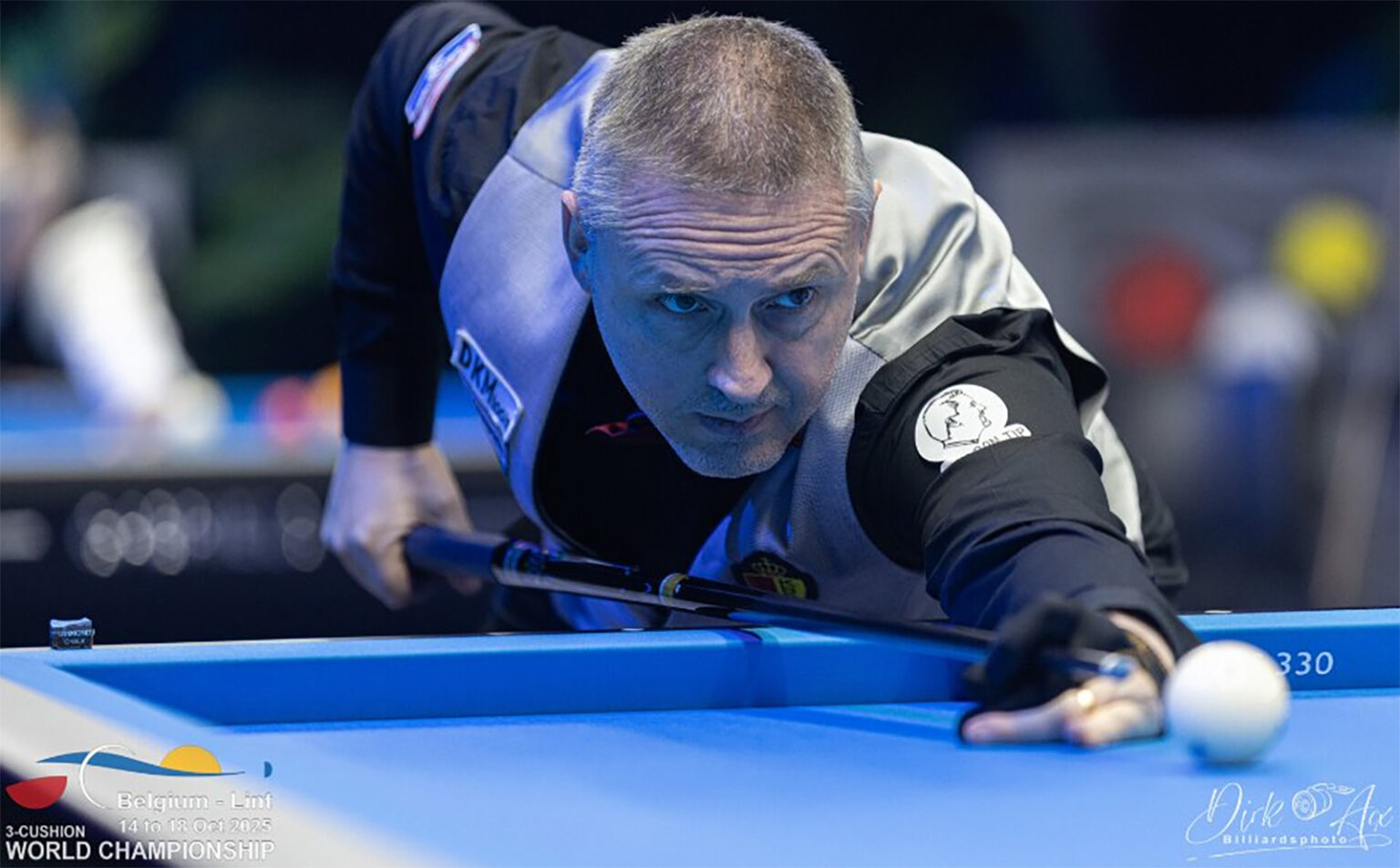
Frédéric’s Return to the UMB Tour & Carom World Title
How does it feel to be World Champion again?
It’s something special because I only resumed playing at the UMB in May 2024 at the World Cup in Vietnam. That was just six weeks after having both hips operated on. For several years, my knees had been hurting because of that. The hip surgery itself is quite heavy in the first weeks, but the rehabilitation doesn’t last too long. Still, it was a mistake to start competing again so quickly because I was suffering a bit. But I still had a very good tournament.
I beat some high ranked players during the group stage and in the knockout stage. I reached the quarterfinals even though I had to go through all the qualifying rounds. From the first round on Monday until Saturday, I played twelve matches, which is pretty good for a comeback “on one leg,” so to speak.
Before playing the World Cup in Vietnam, I remember being ranked 3,214 in the UMB ranking. But all the players behind me also had zero points, so basically, I was last. I started climbing back up the ranking little by little, but I couldn’t play all the tournaments for various reasons. I didn’t go to Korea that year, nor to Colombia last February. Despite that, I kept moving up slowly.
Obviously, when you start from zero, you move up quickly. I earned points at every tournament. I reached the final at the World Cup in Veghel, a semi-final in Porto, and many quarterfinals, so overall, very good results. Despite not winning a tournament.
Coming back to the UMB and starting from the bottom of the ranking must have put some pressure on you?
Originally, I came back to play tournaments in a positive atmosphere and enjoy each game. But also, it puts a lot of pressure because there are many players, good players, who start competing from the very first days. There are always strong players who begin on Mondays because not all of them play every tournament. The groups are made of three players. The matches are shorter at the beginning. 30 points, then it goes up to 35–40 points. But at 30 points, you’re not safe from bad surprises. I had a tournament in Turkey where I was caught off guard during the third qualification. I lost in the third knockout round. But those things happen. I knew what I was capable of when returning to the UMB, even if you never know what will happen. And when you see yourself moving up quickly in the ranking, it motivates you even more.
At what point did you get back into the Top 14 to get the “protected” status?
After Porto in July 2025. I was then protected for the next World Cup in Antwerp, which was scheduled in October, the week before the World Championship. It took me 8 World Cups to get there, which is fairly quick.
When you are in the Top 14, you start directly on Friday in the group stage because you get a protected status, which is very important.
However, for the World Championship, I wasn’t ranked high enough. There are two rankings: the UMB events ranking and the world ranking. Since I hadn’t played any UMB events for five years, I didn’t have enough points to qualify.
Was your goal to climb fast enough to earn automatic qualification for the World Championship?
No, because the World Championship wasn’t the ultimate objective but one of the most important. My goal was to get into the Top 14 because that gives you protected status: it gives you peace of mind by starting on Friday and you automatically receive invitations to every major tournament.
So the World Championship wasn’t the main goal at that moment. But the objective is to play all the big tournaments, and the World Championship is one of them.
How were you able to play the World Championship despite your ranking?
I received a Wild Card from the Belgian organiser. In theory, I shouldn’t have played in Antwerp because I was slightly too low in the world ranking, one or two places short. Modestly speaking, it’s obvious that for the organiser, it made sense to give me the Wild Card considering my reputation in Belgium. And of course, it was a great opportunity for me.
I wonder if a Wild Card has ever won a World Championship before me. It’s possible, because in general Wild Cards aren’t given to favourites. They’re given to local players since the favourites are usually well ranked.

Handling Pressure & Thriving in Elite Carom Billiards
How did the World Championship in Antwerp go?
First, there was the World Cup in Antwerp the week before, and it didn’t go well for me. I didn’t play well. I lost in the last 32, far below what I expected. I didn’t play well overall, and I didn’t really know why.
Losing that World Cup so early brought me back to earth. It hit me hard. A wake‑up call, reminding me that nothing is ever guaranteed. So I came back the following week for the World Championship with a much more focused and less frivolous mindset.
I’m a player who loves the game, and sometimes I lose myself a bit. I realised I needed to work on that. So that World Cup was a bad rehearsal, but in the end it led to a great performance at the World Championship because things turned out completely differently.
The group stage wasn’t particularly easy. I was with 2 Koreans, and we know Koreans are tough to play. I won my first match and already had a better average than the 2 other players, so nothing could really happen to me ranking‑wise. I lost my second match, even though I played well, but I still finished first in my group. From the last 32 onward, I played well in every match. Very focused, with a strong general average.
I played very well in the semi-final, but I didn’t start the final well. I wondered what was happening because my start was catastrophic. Luckily my opponent also didn’t start strongly. We both began very slowly, then he took a slight lead. But that’s when I started playing well and overtook him. The end was stressful, of course. It could have gone either way. But in the end, I felt good. I felt that I wanted to win this game because I was once again very focused and mentally strong.
I played well overall, except for the start of the final. A final is always stressful. There were 600 or 800 people in the venue. I was playing a Belgian, Eddy Merckx, in Belgium. So the crowd was somewhat divided but fair. The organisers couldn’t have dreamed of a better scenario.
How did you handle the pressure?
You live with pressure, but the strength of a player is being able to control it when necessary. That’s why I was happy. It went well because when you feel pressure, sometimes you can’t control it. For me, at the World Championship, it wasn’t anything different. It was just another tournament. I’ve been playing for 35 years. I’ve played many tournament finals. It wasn’t the first time. But sometimes, for reasons you can’t explain, your mind isn’t clear. You’re stressed, your arm isn’t good, your body doesn’t respond. That’s when you need mental strength to get everything back in place quickly.
How did it feel to become World Champion for the fourth time?
It’s always great to win a tournament, a World Cup or a World Championship. But the sensation is the same. Sure, it’s the biggest tournament you can win. But the feeling is the same when you win a final, whether it’s a World Cup or a World Championship. The tension is the same, the opponents are the same, the sensations are the same. But afterward, you realise that you’ve actually won a World Championship. Not necessarily in the moment. At the time, you don’t think about it.
It’s the others who make you realise you’ve achieved something special: the media, people congratulating you on social media. The post I made about this victory received more comments and likes than any other. It shows that for fans, a World Championship win is different from a World Cup win.
But from a sporting perspective, it’s the same. The first time I won the World Championship, it was truly something special. But later, when you start winning tournaments everywhere, you feel the satisfaction in the moment, but afterward all you want is to go home and rest. Once it’s over, the pressure drops and I just want some rest.
What motivates you to keep winning titles when you’ve already won everything?
When I go to a tournament, I want to enjoy it but the main goal is to win. Baron de Coubertin said that the most important thing is to participate. That’s not true. I want to win. I don’t go to competitions for tourism. The feeling of victory is the biggest motivation.
Is your image important to you?
Yes, my image is very important. I want people to remember me as someone decent, friendly, approachable. I don’t want anyone to be able to reproach me for anything bad.
Unfortunately, I got attacked during the last few years by people who tried to damage my image. I tried to defend myself sometimes but I realised it was not worth it. I know my values and who I am, and people who know me and appreciate me, don’t need any proof. Finally, it is the most important.
I don’t show much emotion at the table because it hurts your results. When you show negative emotions, your opponent becomes stronger because he sees that you’re not well. If I miss a point, I sit down. I don’t make a scene.

The Future of Carom Billiards Through Frédéric’s Eyes
What do you see ahead for the rest of your career?
I play less than before. 10-15 years ago, I played 200 official matches per year. An average of two matches every three days. I was driving 50,000 to 60,000 km per year. I played every competition, every league. I played in France, Belgium, the Netherlands, Germany. I played for a team in Spain. Sometimes in Portugal. I was away from home three or four times a week.
Now, depending on my personal schedule, I choose where to play without any obligation because personal life is very important… And now I try to focus much more on tournaments. It had become unmanageable for me. With age, I refocus. Now I play around 60–70 matches a year.
And how do you see the evolution of carom billiards in general?
It’s evolving a bit, step by step, because there’s still a media coverage problem. With streaming, the sport is a bit more accessible. But TV is still quite closed to it. Prize money helps visibility. Prize money attracts media. When Luca Brecel became Snooker World Champion for instance, he won the title and earned 500,000 euros for this tournament. And in Belgium, people still talk about him regularly, even two years after claiming his title. Meanwhile, in Carom, prize money is too low to attract media, especially TV. To get better media exposure, prize money must rise; but to raise prize money, you need more media exposure. It’s complicated. It’s a sport that remains too confidential.
But the world level is improving. In some countries, young people play a lot. Billiard is very popular in some Asian countries, in Turkey and South America. More people playing, more clubs are created in many different cities, more chance that young players get in touch with it and get interested in the game, and billiard will be more popular.